Restaurant Tech Trends 2025: Harness AI, Automation & Data
Summary Highlights
Restaurant technology is evolving into a strategic tool for reducing costs, enhancing guest experiences, and preparing for the future. In 2025 and beyond, key trends like AI, contactless payments, dynamic menus, robotics, and sustainability will redefine dining. With Voosh, you can leverage delivery data, automate disputes, and monitor performance to stay ahead of the competition.
Why Technology Matters for Restaurants in 2025
As delivery giants reshape the foodservice landscape, independent and multi-unit operators face a simple truth: customers expect convenience, personalisation and speed, while costs and labor challenges continue to rise. Recent industry research notes that 41 % of restaurants plan to invest in AI technology to improve business forecasting and operational efficiency, and AI chatbots now handle up to 70 % of customer inquiries at hotels worldwide ftsg.com. That statistic underscores how quickly technology is changing the hospitality sector.
Restaurant technology trends 2025 refers to the emerging tools and processes – from contactless payments to AI‑powered analytics and robotics – that restaurant owners need to stay competitive. These innovations go beyond shiny gadgets; they help reduce waste, increase sales and deliver a better guest experience. In short, adopting the right tech stack is no longer optional.
Key Restaurant Technology Trends for 2025
AI & Predictive Analytics: Smarter Forecasting and Personalization
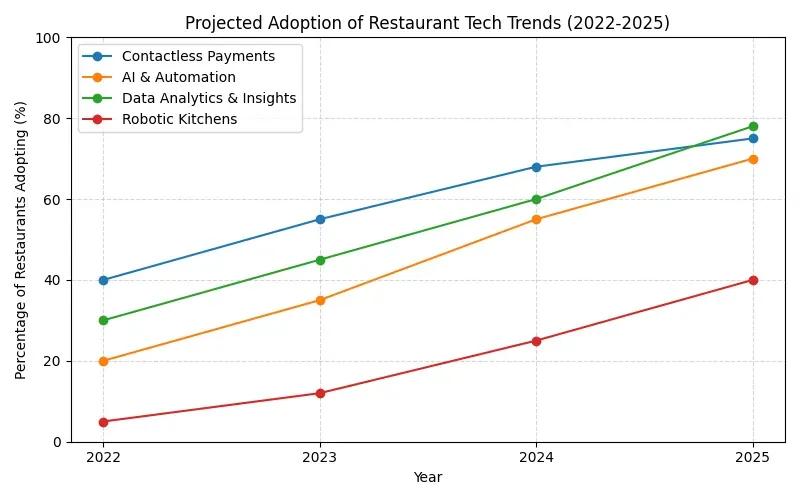
Artificial intelligence has moved from novelty to necessity. According to the Future Today Strategy Group’s 2025 Tech Trends report, 41 % of restaurant operators plan to invest in AI for forecasting and efficiency ftsg.com. Predictive algorithms can analyze historical sales, weather patterns and local events to forecast demand. That means smarter staff scheduling, reduced food waste and improved guest satisfaction.
AI also powers personalized upselling. By analyzing customer behaviour across third‑party delivery platforms, algorithms can suggest add‑ons or promotions that resonate with individual diners. For example, Voosh’s platform uses machine learning to detect order patterns and automatically optimize promotions. It even helps operators file disputes automatically, recovering 2–8 % of delivery revenue with a > 80 % win rate. That win rate isn’t just a marketing claim – it’s backed by data gathered across hundreds of restaurants.
Contactless and Mobile Payments: Frictionless Transactions
The pandemic accelerated the shift toward cashless, touch‑free payments, and the trend shows no signs of slowing. Contactless payment technologies generate valuable data – they reveal purchasing habits, optimize inventory, and enable targeted marketing ftsg.com. Operators that adopt mobile wallets, NFC payment terminals and QR‑code systems reduce checkout times and boost customer confidence.
Moreover, contactless payment adoption is a stepping stone to loyalty programs. Guests who pay through digital wallets are more likely to opt in to rewards, which in turn feeds data back into your marketing engine. Integrating your payment system with a data platform like Voosh ensures you can reconcile every transaction across DoorDash, Uber Eats and POS systems in one place – no more spreadsheets.
Dynamic Menus and Self‑Service Kiosks
Dynamic or “smart” menus are digital boards that adjust pricing and availability in real time. Self‑service kiosks empower guests to browse, customize orders and pay without waiting. These features are part of a broader trend toward guest‑facing innovations that create emotional connections and personalized experiences ftsg.com.
For operators, the benefits are tangible: dynamic menus highlight high‑margin items, sell out items quickly and automatically upsell combos based on time of day. When paired with a delivery intelligence platform, you can push the same smart suggestions across DoorDash and Uber Eats, ensuring consistent brand messaging. Self‑service kiosks also free staff from taking orders, allowing them to focus on hospitality.
Robot‑Assisted Kitchens and Automation
Robotic arms flipping burgers or assembling salads may sound futuristic, but automation is here and scaling fast. Robots improve throughput and consistency, reduce human error and lighten the load on an increasingly scarce workforce. They can handle repetitive tasks like frying, dispensing drinks or even plating dishes.
But automation doesn’t stop at hardware. Software automation, such as Voosh’s downtime controller and operational alerts, spots order bottlenecks and kitchen outages before they impact guests. Real‑time alerts about missing menu items or late drivers help managers fix issues quickly. When combined with AI forecasting, robotics creates a powerful mix of efficiency and precision.
Delivery Data Platforms & Integration
Most technology trend articles overlook a crucial piece of the puzzle: data integration. With multiple third‑party marketplaces, POS systems and payment providers, operators drown in spreadsheets and disjointed reports. That’s where platforms like Voosh come in.
Voosh’s financial reconciliation suite pulls orders, refunds and fees from every delivery app and POS into a single dashboard. Operators can reconcile payouts with bank statements, spot under‑reporting and track profitability by location. The platform also tracks promotion and ad ROI, helping you identify which discount actually drives incremental orders.
Another underrated advantage is automated dispute and chargeback recovery. Delivery apps often reject refund claims because restaurants lack evidence or time. Voosh automatically files disputes with the right documentation and follows up until you receive credit. Many restaurants recover 2–8 % of delivery revenue this way.
By integrating your data, you turn information into action. Want to know how contactless payments affect average order value on Uber Eats? Or which menu items trigger negative reviews? Voosh’s dashboards answer these questions at a glance.
Sustainability and Waste Reduction
Consumers increasingly choose eco‑conscious brands, and regulators are clamping down on waste. The Tech Trends report lists monitoring food waste and impact among the top innovations. Solutions include smart inventory systems that track expiry dates, AI‑powered portioning tools that minimize over‑prepping, and sustainable packaging like edible or compostable materials.
Sustainability is not just about feel‑good marketing. Reducing waste lowers costs and improves margins. For example, a Voosh customer noticed consistent over‑portioning on a best‑selling bowl. By analyzing item‑level data and adjusting recipes, the restaurant cut ingredient costs by 12 % while maintaining customer ratings.
How to Implement New Tech in Your Restaurant
Adopting new technology can feel daunting. Follow these steps to build a future-ready operation:
- Identify pain points: Start by listing your biggest headaches – inaccurate payouts, order errors, labor shortages or slow checkout lines. Prioritize the areas hurting profitability.
- Benchmark your performance: Use current data to establish baselines. For example, track your win rate on disputes, average order value, delivery times and review sentiment. Platforms like Voosh provide dashboards that consolidate this information across marketplaces.
- Research solutions: Explore tools that address your pain points. For forecasting, look at AI analytics; for payments, evaluate contactless terminals; for kitchen automation, assess robotics vendors. Make sure the tools integrate with your POS and delivery platforms.
- Pilot and integrate: Roll out one technology at a time in a pilot location. Integrate it with your existing systems to avoid siloed data. For instance, when testing dynamic menus, sync pricing with your delivery listings to ensure consistency.
- Train your team: Technology fails when staff don’t know how to use it. Invest in training and create cheat sheets. Highlight benefits – shorter lines, fewer mistakes – to encourage adoption.
- Monitor results: Compare the pilot’s performance against your baseline. Did labor hours drop? Did revenue per order increase? Tools like Voosh make it easy to measure improvements in real time.
- Scale gradually: Once you see positive ROI, scale to other locations. Continue monitoring and adjust processes as needed.
- Stay agile: Technology evolves quickly. Plan regular reviews of your tech stack and keep an eye on emerging trends like autonomous restaurants, AR ordering and edible packaging
Measuring ROI and Overcoming Challenges
Cost and complexity are the biggest barriers to adopting new tech. Upgrading POS systems, retrofitting kitchens for robotics or investing in AI forecasting requires capital. The key is to tie each investment to a measurable outcome:
- Revenue recovery: Voosh’s automated dispute filing recovers 2–8 % of delivery revenue with an over‑80 % win rate. That’s money back in your pocket, not lost to wrongful charges.
- Labor savings: Robots and AI scheduling can cut kitchen labor by 10–30 %. Combined with self‑service kiosks, you can reassign staff to hospitality roles.
- Sales growth: Smart promotions and dynamic menus drive higher average order value. Pair contactless payments with loyalty programs to increase repeat visits.
- Reduced waste: AI demand forecasting and portion control reduce food waste, lowering food costs by up to 15 %.
Challenges remain. Integrating disparate systems can create data silos if you choose vendors that don’t play well together. Staff might resist change, fearing job losses. To overcome these hurdles, involve your team early, choose scalable solutions that integrate easily and communicate the benefits. Remind staff that technology augments their work rather than replacing it. In fact, AI and robotics allow teams to focus on creativity and hospitality instead of repetitive tasks ftsg.com.
Looking Ahead: The Future of Restaurant Tech
Innovation doesn’t stop with the current trends. The Tech Trends report forecasts autonomous restaurants featuring robot chefs and dynamic menus ftsg.com and even engineered food and meals that reduce waste ftsg.com . Other future developments include:
- Immersive experiences: Augmented reality menus and holographic projections that let guests visualise dishes before ordering.
- Predictive maintenance: IoT sensors on kitchen equipment will alert operators before failures, avoiding downtime.
- Edible packaging: Packaging that dissolves safely or adds flavor reduces waste and enhances the dining experience.
- Hyper-personalization: Apps will suggest menus based on nutritional preferences, allergies and carbon footprint, creating tailored experiences at scale.
- Hybrid kitchens: Ghost kitchens will merge with dine‑in spaces, sharing equipment and staff to maximize efficiency.
Whatever the future holds, one thing is clear: operators who embrace data, automation and sustainability will thrive, while those clinging to outdated methods risk being left behind.
Conclusion: Bring Voosh Intelligence to Your Tech Journey
Restaurant technology is not just about gadgets; it’s a strategy to control costs, delight guests and future‑proof your business. In 2025 and beyond, AI, contactless payments, dynamic menus, robotics and sustainability will shape the dining landscape. By integrating your delivery data, automating disputes and tracking performance with Voosh, you can turn these trends into competitive advantages.
Ready to see how intelligence can transform your operations? Book a demo and start harnessing the power of technology today.
FAQ
What are the top restaurant technology trends for 2025?
The most influential trends include AI‑powered analytics, contactless and mobile payments, dynamic menus and self‑service kiosks, robot‑assisted kitchens, data integration platforms and sustainability solutions. These tools help restaurants improve forecasting, deliver frictionless customer experiences and reduce waste. ftsg.com
How can technology improve third‑party delivery performance?
By integrating marketplace data, operators gain visibility into order volumes, fees, refunds and payouts. Platforms like Voosh automate dispute filing, track promotion ROI and reconcile finances across DoorDash, Uber Eats and POS systems. This reduces revenue leakage and allows managers to make smarter decisions.
Will AI replace human staff in restaurants?
No. AI and robotics handle repetitive tasks like forecasting demand or preparing standard dishes, freeing human employees to focus on hospitality and creativity. Research shows that 41 % of restaurants plan to invest in AI to improve operations, not to eliminate jobs ftsg.com . Human oversight remains essential for quality, culture and customer connection.
How do I measure ROI on restaurant technology investments?
Start with baselines for revenue, labor hours, dispute win rates and customer satisfaction. After implementing new technology, track changes using integrated dashboards. Key metrics include revenue recovery from disputes (Voosh recovers 2–8 %), labor cost reductions from automation, increased average order value from dynamic menus and lower food costs from waste reduction.